Author


The research community at the Institute includes visiting scholars, consultants, economists, research analysts, and research assistants. These scholars bring varied backgrounds, interests, and expertise to research that deepens our understanding of economic opportunity and inclusion as well as policies that work to improve both.
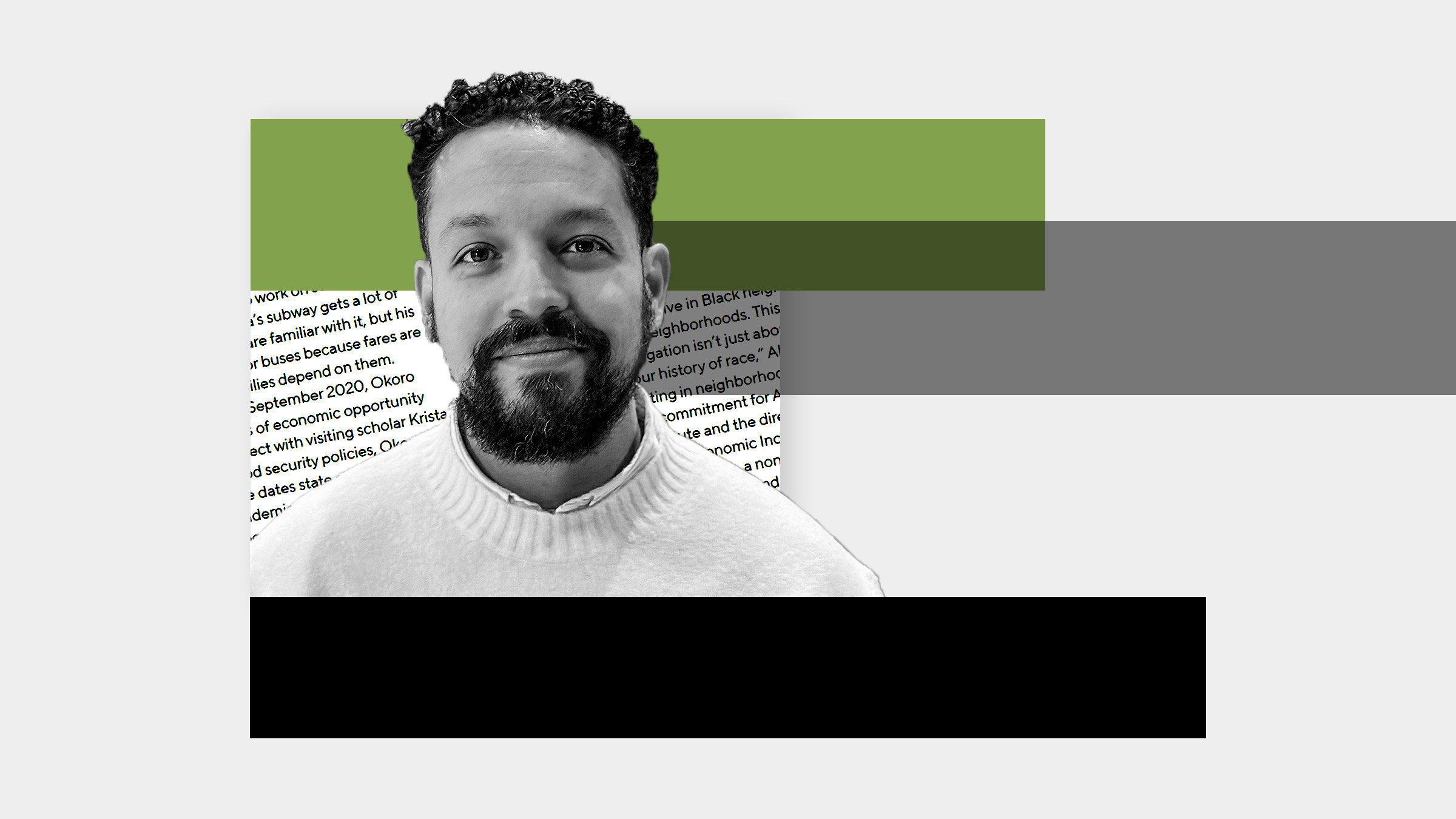
Kareem Haggag likes to describe his research as lying at “the intersections of economics, psychology, and political science.”
In college, he found inspiration in all these fields and couldn’t decide on just one. “I changed my major every single year of undergrad,” Haggag said.
Eventually, economics won out. “I just tend to have scattered and diverse interests, and there seems to be a little bit more tolerance for economists to dabble across areas,” he said.
This intellectual wanderlust has led Haggag to topics ranging from the effects of flexible pay schedules on Uber drivers to how much an extra point on the ACT exam affects attendance at four-year colleges.
Haggag’s latest research, involving equity financing for livestock farmers, or herders, touches on human behavior and economic development.
In the developing world, microbusinesses have long had access to microloans. But many business owners consider loans too risky, and among Muslims (of whom there are many in developing countries), there are religious concerns over interest rates.
Microequity—very small investments—may sidestep those concerns and create opportunities for debt-averse people.
For banks, equity leads to new concerns, which may be why microequity investments are not widely available, according to Haggag. With loans, a borrower risks losing their own investment if their business venture fails. With microequity investments, banks share the risk. This could be a problem for banks if the relative safety of equity attracts less productive businesses or those that take bad risks. Economists call this “adverse selection.”
One of Haggag’s goals was to test how likely adverse selection was by working with an Egyptian nonprofit’s microequity program. He found that in this context, risk-sharing actually attracted herders who are more productive. The program showed enough promise that Haggag and his co-author are now consulting with a national bank to scale up.
There may be a role for microequity even in the U.S., where there is widespread acceptance of credit cards, mortgages, and other forms of debt, according to Haggag. Economists have found that many Americans do have an aversion toward certain forms of debt, such as student loans.
While Haggag’s research leaps from one topic to another, it often involves questions about poverty and inequality. He said he’s had these questions for as long as he can remember: Why is there so much poverty in Egypt, his parents’ homeland? Why did disparities exist among his grade school classmates in Tennessee?
“Economics provides a broad toolkit that could allow you to study the causes,” Haggag said.
This article is featured in the Spring 2026 issue of For All, the magazine of the Opportunity & Inclusive Growth Institute
More scholar spotlights from this issue
Dan Hartley—“Beating up” assumptions
Oksana Leukhina—A higher purpose for higher ed access
Tu-Uyen Tran is the senior writer in the Minneapolis Fed’s Public Affairs department. He specializes in deeply reported, data-driven articles. Before joining the Bank in 2018, Tu-Uyen was an editor and reporter in Fargo, Grand Forks, and Seattle.