Author


Article Highlights
- With Mount Rushmore, Badlands, and Black Hills, tourism is major driver of local economy
- Arrival of new stealth bombers promises to increase already significant impact of Air Force base
- Rapid City, with its small-town feel, is popular place to retire, driving population growth
Among the dues-paying members of the Black Hills & Badlands Tourism Association in Rapid City, South Dakota, are, as expected, tourism businesses such as hotels and restaurants. But the group’s membership also includes insurance agents, garbage collectors, and a wholesaler of janitorial supplies.
“If you stay in a hotel, toilet paper, Kleenex, wrapped cups for coffee, cleaning supplies used by housekeepers—that’s what we supply,” said Abby Matthews, the office manager at Black Hills Chemical & Janitorial Supply.
So many of her customers are in tourism that it makes sense to join the tourism group to keep up with industry trends, she said. “If they’re not busy, we’re not busy.”
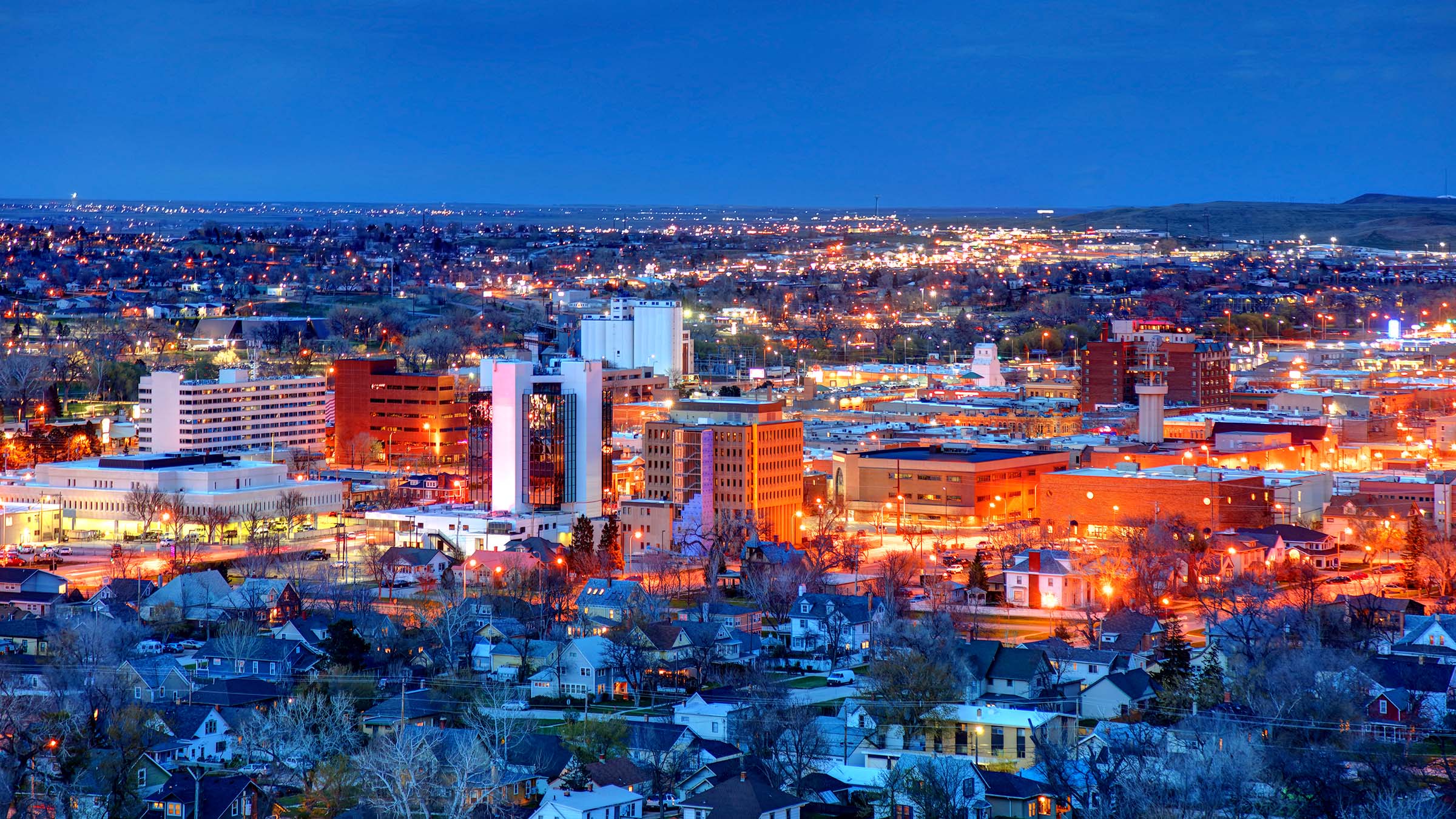
It’s not an exaggeration to call tourism the economic lifeblood of the three-county Rapid City metropolitan area, which boasts four National Park Service sites and South Dakota’s most popular state park. The area also attracts a significant number of new residents, Air Force personnel, and those seeking health care.
As a result, business sectors that benefit from the movement of people to Rapid City have an outsized effect on the area economy when compared with other communities in the Great Plains and the adjoining Intermountain West region.
In recent years, these sectors have helped propel the area’s economic expansion, with gross domestic product (GDP) growing by 3 percent a year between 2019 and 2023. In the preceding five years, GDP grew at half that rate.
Minneapolis Fed President Neel Kashkari visited Rapid City in October as part of an outreach effort. He also sought to better understand how macroeconomic trends, such as inflation, affect the area.
Parks and presidents
Rapid City is located in the Black Hills, a small mountain range not far from where the Plains meet the Rockies. Despite being isolated from many larger communities, tourists have been coming to the hills since the first scenic highways were built here a century ago.
To get a sense of how important tourism is to the area’s economy, consider that spending by visitors totaled $1.2 billion in 2023, according to the state tourism agency (Figure 1). That’s equivalent to 12 percent of the area’s GDP. During the pandemic, when outdoor recreation surged, tourism spending surged to $1.4 billion.
Compared with other metro areas in the Plains and Intermountain region, business sectors affiliated with tourism have a much bigger share of the Rapid City area GDP. For example, accommodation and food services made up 6 percent of GDP and retail trade 10 percent (Figure 2). The share of GDP for both sectors is larger than more than 90 percent of other metro areas in the region, according to Bureau of Economic Analysis data.
The top draw is Mount Rushmore, which many visitors say is on their bucket list, said Ally Formanek, CEO of Visit Rapid City, the city’s tourism agency. Other top attractions include Custer State Park and Badlands National Park, she said.
These are out-of-town attractions, but their influence is felt in town. Tourists may visit the attractions during the day, but Rapid City is where many spend the night, according to Formanek. As the area’s largest city, it has the largest selection of lodging and dining options.
New mission, new growth
There are a few other ways the Rapid City area attracts people. One is for the Air Force to bring them. Ellsworth Air Force Base has been doing that since World War II.
At its peak during the Cold War, the base was home to 7,000 military and civilian personnel. According to the base, personnel numbers are now around 4,100, equivalent to 5 percent of the area’s civilian labor force. That makes the base the area’s largest employer. Expenditures by the base and compensation paid to its personnel combined is equivalent to 7 percent of GDP.
Ellsworth will become an even larger employer when it trades in its Cold War–era B-1B bombers for B-21 bombers. The base is one of three nationwide to receive the stealthy new aircraft. The Air Force expects that during the transition when both bombers are present, personnel numbers will swell to 6,300 before settling down to 5,900 when the last B-1Bs leave (Figure 3). The number of dependents would increase to 8,100 before settling at 7,800.
Taylor Davis, workforce development director at Elevate Rapid City, the area’s economic development agency, said the B-21 mission is projected to result in a 40 percent increase in payroll and a doubling of expenditures compared with 2023.
The new bomber is still at least a year away from arriving, but the area is already feeling its impact. So far, the Pentagon has committed $1.2 billion in construction, ranging from a nuclear weapons maintenance and storage facility to hangars and shelters of all kinds, according to USASpending. That led to a 12-fold increase in spending by the base in 2023 compared with 2020, according to reports from the base.
“More workers and suppliers in the region mean more local dollars circulating through restaurants, retail, and services,” Davis said. “The momentum from military construction is strengthening multiple sectors of our economy.”
Retirement destination
Besides tourists and airmen, the Rapid City area is also attracting many health care patients and new residents.
Health care makes up 14 percent of GDP, a larger share compared with 92 percent of metro areas in the region.
One explanation for the dominance of health care in Rapid City is the large size of its health care market. The nearest metro area with a comparable number of staffed hospital beds is five hours away by road. The area’s primary health care provider, Monument Health, boasts a service area that’s home to 450,000, triple the population of the Rapid City area, according to Fitch Ratings.
As for new residents, the area’s population has grown about 1 percent a year since 2010. This growth rate is close to the average for metro areas in the region, though a lot faster than the average for U.S. metro areas.
But where Rapid City stands out is in the growth of the 65-and-older population (Figure 4). The number of older adults has increased 4.3 percent a year since 2010, though that pace has slowed since the pandemic. Today, older adults account for a fifth of the population.
Many people come here to retire, and it often starts with a visit to the area, said tourism director Formanek. “We’ve got those big amenities, but we still have that small town roots kind of feel, which people really like.”
An economy running hot
The Rapid City area’s growth has not been without challenges.
A significant number of workers, particularly in tourism-affiliated sectors, earn lower-than-average wages. For example, in 2023, employment in accommodation and food services and retail represented 33 percent of total employment but only 16 percent of total personal earnings, according to government statistics.
Demand for housing, driven by new residents, has outpaced supply, driving up costs. During the pandemic, rent grew by as much as 7 percent year over year and home prices by as much as 56 percent (per square foot), according to data compiled by Elevate Rapid City and Realtor.com, respectively.
The supply of workers has not kept pace either. The unemployment rate in the Rapid City area has long been low compared with most of the region, but it’s been exceptionally low since 2022, averaging 2 percent or less. Employers have struggled to find enough workers.
Some recent indicators suggest that growth is slowing, however. The Census Bureau’s 2024 population estimates show growth slowing to 0.2 percent a year. The state Revenue Department reported gross sales of goods and services, adjusted for inflation, shrinking 0.3 percent in fiscal year 2025, which ended in June.
The silver lining is slowing population growth that has allowed apartment construction to catch up, causing rent increases to slow to a standstill.

Tu-Uyen Tran is the senior writer in the Minneapolis Fed’s Public Affairs department. He specializes in deeply reported, data-driven articles. Before joining the Bank in 2018, Tu-Uyen was an editor and reporter in Fargo, Grand Forks, and Seattle.